Marscoin Whitepaper: Trustless-Ledger Technology Implications for a Martian Society
The original Marscoin whitepaper by Lennart Lopin, James Burk, and Philipp Puaschunder — exploring why Mars needs its own cryptocurrency and how blockchain technology solves the unique challenges of interplanetary settlement.
Abstract
Marscoin is a peer-to-peer cryptocurrency designed from first principles for the unique constraints of a permanent human settlement on Mars. First launched in January 2014, it addresses the fundamental question: How does a society 225 million kilometers from Earth manage its own financial infrastructure?
This document explores the implications of trustless-ledger technology for a Martian society, the technical design decisions that differentiate Marscoin from terrestrial cryptocurrencies, and the philosophical framework for decentralized governance beyond Earth.
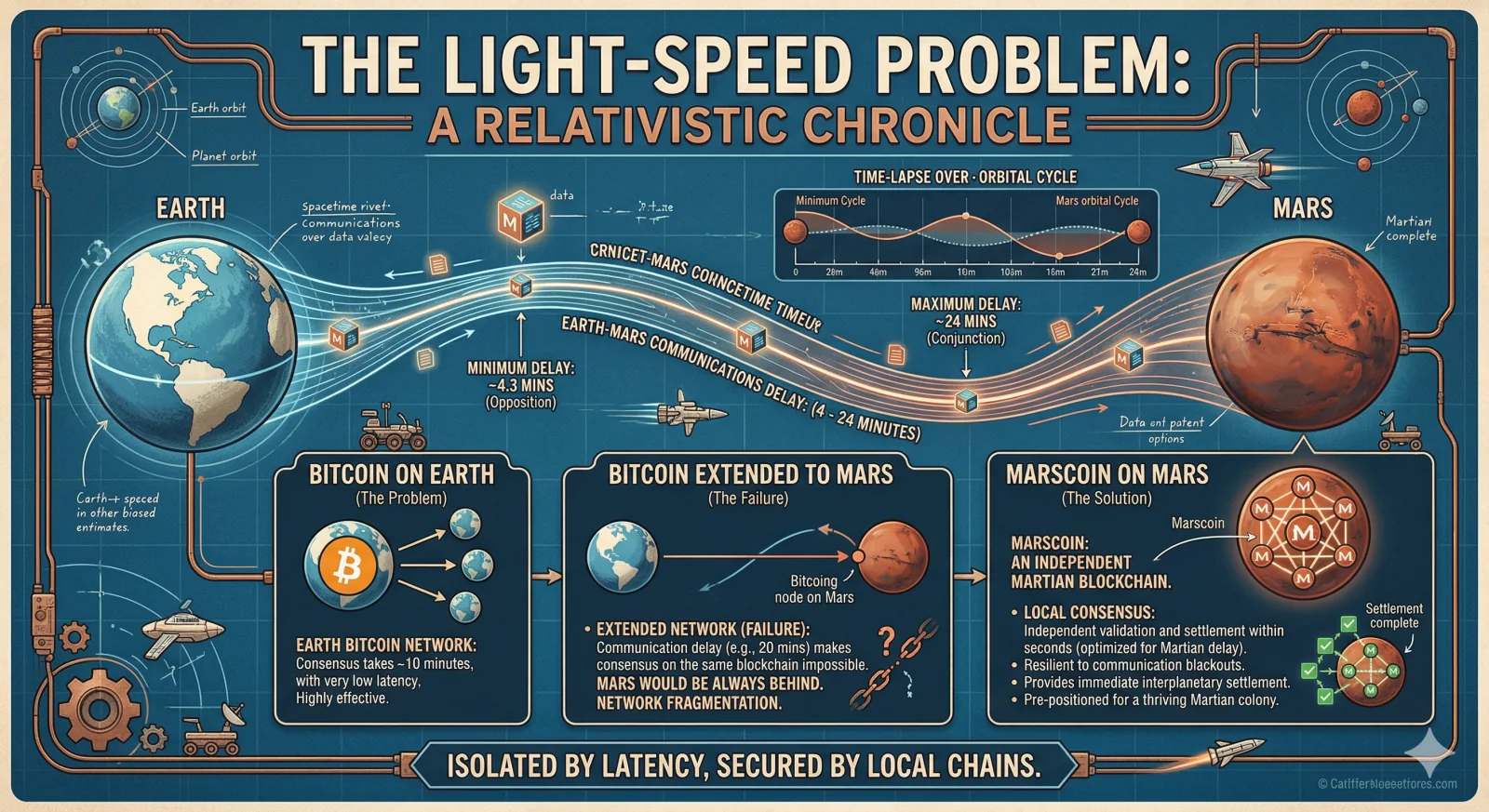
The Light-Speed Penalty
The single most important constraint that drives Marscoin’s design is the communication delay between Earth and Mars.
At closest approach (opposition), the one-way light-speed delay is approximately 4 minutes. At greatest distance (conjunction), it reaches 24 minutes. The average round-trip time for a signal is approximately 28 minutes.
This delay has profound implications:
- No real-time financial transactions with Earth-based systems are possible
- No centralized banking infrastructure can operate across this gap
- No government on Earth can effectively regulate or control financial activity on Mars in real-time
- Settlement-based confirmation of any Earth-dependent transaction would take a minimum of 8 minutes under ideal conditions — and up to 48 minutes in the worst case
“The speed of light creates a financial sovereignty that no treaty or agreement can override. Mars will have its own money not because it chooses to, but because physics demands it.”
This is not a theoretical problem for a distant future. SpaceX’s Starship program has placed permanent Mars settlement within the planning horizon of current space agencies and private enterprises. The financial infrastructure must be designed before the first permanent settlers arrive.
Why Cryptocurrency — And Why Marscoin Specifically
The Case for Cryptocurrency on Mars
Any financial system for Mars must satisfy several non-negotiable requirements:
| Requirement | Why | Traditional Solution | Mars Problem |
|---|---|---|---|
| Decentralized | No single point of failure | Central banks | Cannot depend on Earth |
| Self-sovereign | Must operate independently | Government backing | No Mars government (yet) |
| Low energy | Power is precious on Mars | Data centers | Every watt matters |
| Fast settlement | Commerce can’t wait hours | Card networks | Earth networks unreachable |
| Transparent | Trust in a small community | Auditors | No audit infrastructure |
| Programmable | Governance needs smart rules | Legal systems | No courts, no lawyers |
Cryptocurrency — specifically Proof of Work cryptocurrency — satisfies all six requirements simultaneously. No other financial technology does.
Why Not Just Use Bitcoin?
Bitcoin is the obvious candidate, but it has specific properties that make it suboptimal for Mars:
- 10-minute block times are too slow for a small settlement where every transaction matters
- Enormous energy consumption — Bitcoin’s hash rate requires gigawatts of power. Mars has none to spare.
- Earth-dominated mining — A Mars Bitcoin node would always be 4–24 minutes behind Earth’s chain tip, making it vulnerable to reorganization
- Cultural sovereignty — A Mars settlement needs a currency that is theirs, not an extension of Earth’s financial system
Marscoin is purpose-built for these constraints: 2-minute block times, Scrypt Proof of Work (far more energy-efficient than SHA-256 at equivalent security levels for a small network), and a community specifically oriented toward Mars colonization.
Technical Design Decisions
Block Time: The Mars Minute
Marscoin’s block time is approximately 123 seconds — chosen deliberately because it is close to one Mars minute (approximately 61.65 Earth seconds × 2).
This is not a vanity metric. Faster blocks mean:
- Quicker first confirmation for point-of-sale transactions
- More granular timestamping for governance votes and logbook entries
- Better throughput for the daily transaction volume of a small but growing settlement
Scrypt Proof of Work
Marscoin uses the Scrypt hashing algorithm rather than Bitcoin’s SHA-256. Scrypt is memory-hard, meaning it requires significant RAM to compute efficiently. This has two critical advantages for Mars:
- ASIC resistance (relative to SHA-256) — general-purpose hardware can mine effectively
- Lower energy per hash at the security levels appropriate for a smaller network
Total Supply: ~39.57 Million MARS
The total supply cap of approximately 39.57 million MARS (39,569,900 to be precise) was chosen to provide:
- Sufficient granularity for microtransactions in a small economy
- A manageable number that avoids the psychological barrier of Bitcoin’s large decimal places
- An early-adopter incentive structure that rewards those who invest in Mars infrastructure before the settlement exists
The Early Adopter Incentive
“Those who support the construction of a new world before it exists deserve to benefit when it does.”
Marscoin’s emission schedule is designed so that early supporters — those who mine, hold, and develop the ecosystem in the years before Mars settlement — accumulate meaningful stakes. When Marscoin becomes the functional currency of a Mars settlement, this early support is retroactively valued by the market.
This is not speculation. It is the same mechanism that funded the development of every successful open-source project: reward the builders.
Blockchain Uses Beyond Currency
The Marscoin blockchain is not limited to financial transactions. The Martian Republic framework extends it to:
Citizen Registry
A decentralized identity system with cryptographic proof of humanity through peer attestation. No central authority issues identity — the community verifies its own members.
Congressional Voting
Blockchain-verified votes using CoinShuffle for ballot privacy. One citizen, one vote, mathematically enforced. No disputed elections, no hanging chads, no authority to overrule the count.
Research Logbook
Scientific observations and experimental data anchored to the blockchain via IPFS hashes. Immutable, timestamped, and independently verifiable — the scientific method encoded in protocol.
Resource Inventory
An immutable ledger of resource utilization — water, power, materials — ensuring transparent allocation in an environment where waste is existential.
Planetary Registry
A cooperative mapping initiative where geographic data is contributed by citizens and anchored to the blockchain, building a shared knowledge base of Martian terrain.
Conclusion
Marscoin exists because physics, economics, and human nature converge on a single conclusion: Mars will have its own money. The question is whether that money is designed thoughtfully in advance, or improvised under pressure after arrival.
By building and testing the infrastructure now — the wallets, the governance systems, the mining ecosystem, the community — Marscoin ensures that when the first permanent settlers step onto Martian soil, the financial and democratic infrastructure they need is already operational, battle-tested, and waiting for them.
The full academic paper is available as a PDF download. Originally authored by Lennart Lopin, James Burk, and Philipp Puaschunder. Presented at the Mars Society International Convention, 2014.